

| Communication team
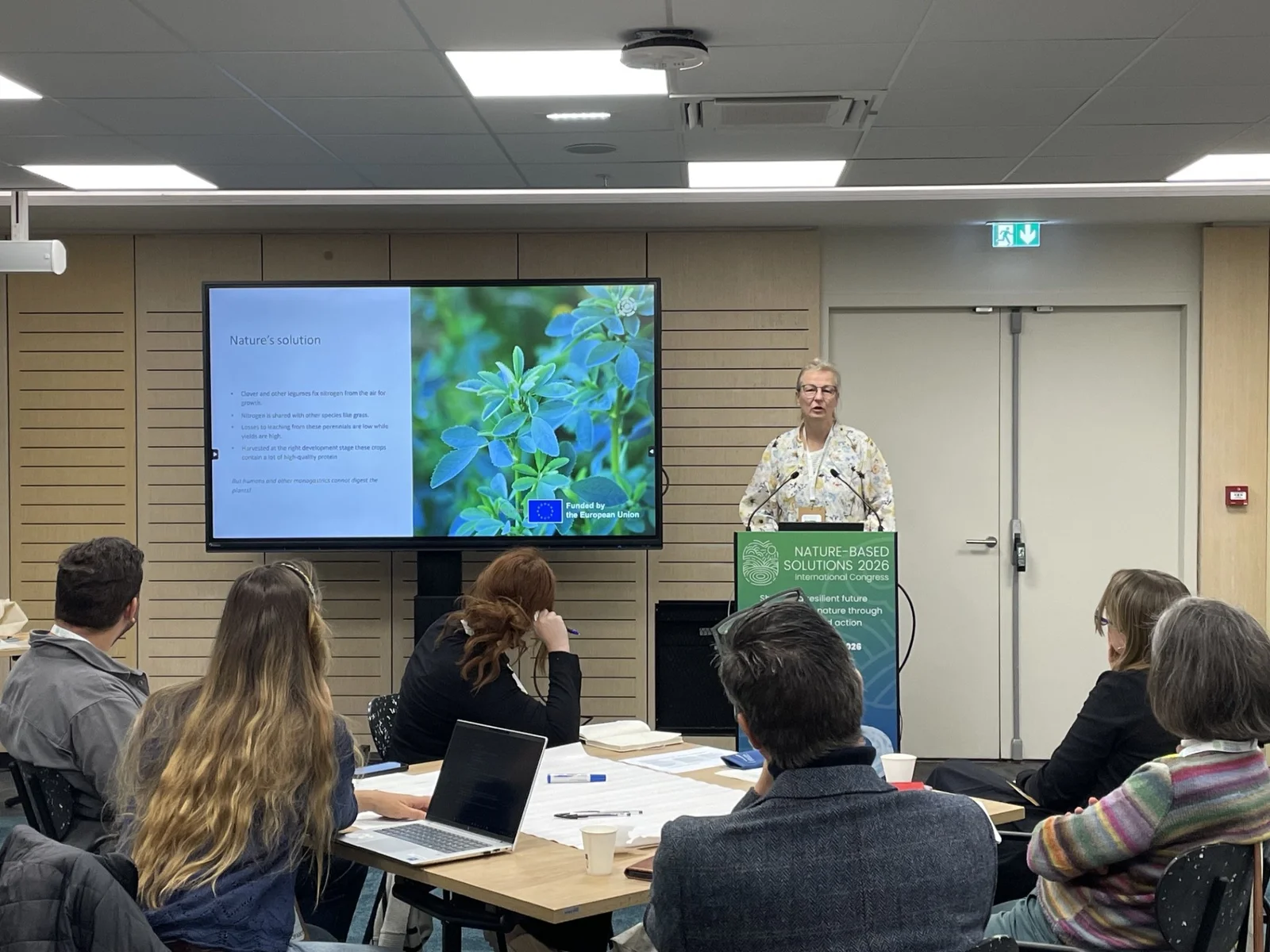
On 4 November 2026, trans4num brought together researchers, practitioners and stakeholders for an interactive World Café at the Nature-Based Solutions International Congress in Paris. The discussions explored a key question: what needs to change to make Nature-Based Solutions more widely adopted in agriculture?
The trans4num World Café, co-hosted by the University of Hohenheim and Klimafonden Skive, with contributions from Pia Strunge Folkmann, Thine Hahnbak and Dr. Qirui Li, provided an opportunity to move beyond the technical and environmental performance of NBS and reflect on the wider conditions needed to support their adoption.
From promising solutions to practical implementation
Nature-Based Solutions offer significant opportunities to improve soil health, nutrient management, biodiversity and the resilience of agricultural landscapes. However, demonstrating their environmental benefits is only part of the challenge.
For these solutions to be adopted more widely, they must also be economically viable, practically applicable and supported by appropriate policies, incentives and market conditions.
Using a participatory World Café approach, participants exchanged experiences and perspectives around three guiding questions:
- What works? Which approaches and conditions support the successful implementation of NbS?
- What stands in the way? What barriers prevent farmers and other stakeholders from adopting or scaling up these solutions?
- What needs to change? Which policy, economic and institutional transformations could enable wider adoption?
The discussions highlighted four important messages.
Four key messages from the World Café
1. Solutions must reflect local realities
Successful Nature-Based Solutions need to be adapted to local environmental, agricultural and socioeconomic conditions.
Participants emphasised the importance of practical approaches that respond to farmers' needs and fit within existing farming systems. Farmer-to-farmer knowledge exchange, opportunities for learning from practical experiences and stronger evidence of biodiversity benefits were identified as important factors supporting adoption.
2. Barriers extend beyond the farm
Even when a solution demonstrates positive environmental outcomes, its wider adoption can be constrained by factors outside farmers' direct control.
Economic uncertainty, complex value chains, limited market access and insufficient financial incentives can discourage investment in new practices.
Addressing these barriers requires looking beyond individual farms and considering the wider agricultural and food systems in which they operate.
3. The costs and benefits of the transition must be shared fairly
One of the central questions emerging from the discussions was: Who bears the costs and risks of transitioning towards more sustainable practices, and who benefits from the outcomes?
Farmers are often expected to implement changes that deliver broader environmental and societal benefits. However, without appropriate compensation, risk-sharing mechanisms and economic incentives, the transition may remain difficult to justify at farm level.
Participants highlighted the need for fairer arrangements that recognise and reward the environmental services provided by farmers.
4. Scaling up requires systemic change
Wider adoption of Nature-Based Solutions depends not only on improving individual practices but also on creating an enabling environment.
Participants called for supportive policy frameworks, market mechanisms that reward ecosystem services and stronger connections between agricultural production and consumption.
At the same time, the transition towards more sustainable agricultural systems must continue to safeguard food security and agricultural productivity.
Moving beyond environmental performance
A central conclusion from the World Café was that ecological effectiveness alone is not enough to ensure the successful scaling of Nature-Based Solutions.
Their long-term adoption also depends on economic viability, institutional support, social acceptance and the ability to integrate these approaches into existing agricultural systems.
This message strongly resonates with the work carried out within trans4num, which combines field-level experimentation with stakeholder engagement and the assessment of the wider conditions influencing the adoption of Nature-Based Solutions.
As the project approaches its conclusion, these discussions provide valuable perspectives on how research results and practical experiences can inform future agricultural policies and support the transition towards more sustainable nutrient management.
Ultimately, the challenge is not only to develop better solutions, but also to create the conditions that allow those solutions to be implemented, sustained and scaled up.
Thank you for contributing!
A warm thank you to all participants who shared their knowledge, experiences and perspectives during the World Café in Paris.
Special thanks to Pia Strunge Folkmann, Thine Hahnbak and Dr. Qirui Li, as well as the teams from the University of Hohenheim and Klimafonden Skive, for their contributions to the session.
The discussions demonstrated once again the value of bringing together different perspectives to address the complex challenges facing European agriculture.