

| Communication team
On 19 November 2025, Rothamsted Research hosted a full-day knowledge exchange event, “Discover the Power of Organic Amendments”. The workshop brought together farmers, advisors, scientists, and policy stakeholders to explore how organic amendments can contribute to more resilient, productive, and sustainable farming systems.
The programme combined expert presentations, group discussions, and an extensive field tour, giving participants the rare opportunity to connect long-term scientific evidence with real-world practice.
Session 1: Compost in Regenerative Agriculture: Understanding Yield and Soil Responses
The day opened with a presentation by Dr. Jonathan Storkey, who provided a comprehensive overview of how compost and other regenerative practices interact over time.
Storkey placed compost within the broader context of regenerative agriculture, explaining how organic amendments both substitute and complement synthetic fertilisers depending on crop rotations and tillage systems. He then guided the audience through results from long-term trials at Brooms Barn and Harpenden, where compost is typically applied at 30 t/ha with cover crops.
Key insights included:
- Consistent yield benefits for barley at Brooms Barn, with increases ranging from 8% to 30% depending on system design.
- More variable responses at Harpenden, highlighting the need to understand site-specific conditions.
- Positive effects on winter wheat yields at both sites across tillage systems.
- Evidence that compost accelerates crop residue breakdown, improves infiltration, and supports beneficial insects such as carabid beetles in reduced-tillage systems.
- A clear long-term contribution to increasing soil organic carbon, especially when compost is combined with reduced tillage.
By framing these findings within ongoing questions around soil function and resilience, Dr. Storkey set the stage for the deeper nutrient dynamics explored in the next session.
Session 2: What Long-Term Experiments Reveal About Carbon, Nitrogen, and Soil Health
The second presentation, delivered by Dr. Stephan Haefele, centered on the Fosters Organic Amendment Experiment, one of the UK's most detailed long-term studies on manure- and compost-based nutrient management.
Haefele explained how the experiment’s structure (comparing farmyard manure, compost, anaerobic digestate, straw, and mixtures, each at multiple carbon and nitrogen rates) allows researchers to distinguish the unique contributions of each amendment type to soil processes.
Among the highlights:
- Organic amendments significantly boost soil organic carbon (SOC) and total soil nitrogen (TSN) in the topsoil.
- Straw-only and untreated plots show clear signs of soil nitrogen depletion, emphasising the importance of balanced organic inputs.
- Crop nitrogen uptake improves across nearly all amendments during six wheat seasons, reflecting higher nutrient availability and better synchronisation with crop demand.
- Nitrogen use efficiency (NUE) remains consistently high, around 80% for manure and compost systems.
- Carbon is not just accumulating at the surface; dissolved organic carbon (DOC) also moves downward into deeper layers (23–46 cm and 46–70 cm), indicating long-term sequestration potential.
Haefele also highlighted ongoing modelling work using DayCent, DNDC, and RothC to better predict long-term nutrient balances, optimise nitrogen strategies, and support decision-making at farm and policy levels.
Session 3: Circular Phosphorus Solutions: Introducing Thallo™ Fertiliser
The final scientific session, led by Robert Dunn, focused on phosphorus, a nutrient often overlooked in regenerative agriculture conversations but essential for crop growth.
Dunn began by outlining the global challenge: rock phosphate is a finite, unevenly distributed resource, heavily dependent on imports and associated with cadmium contamination concerns. With EU cadmium limits tightening, the need for alternative phosphorus sources is urgent.
He then introduced Thallo™, a phosphorus-rich fertiliser produced from abattoir by-products through a two-stage process that virtually eliminates waste. Dunn explained how the system converts edible and non-edible wastes into valuable inputs, resulting in a fertiliser that is naturally low in cadmium and enriched with micronutrients tailored to soil needs.
Trials conducted at Rothamsted showed:
- Grass and wheat yields from Thallo were comparable to or exceeded those from standard NPK fertilisers.
- Significant increases in some micronutrients, such as zinc and phosphorus, in plant tissue.
- Lower cadmium accumulation in wheat fertilised with Thallo compared to crops grown with conventional fertilisers.
- Field trials in 2025 confirmed strong performance in both perennial ryegrass silage and winter wheat.
Dunn’s presentation highlighted not only Thallo’s agronomic potential but also its role in closing nutrient loops, reducing waste, and decreasing dependency on geopolitically sensitive phosphorus sources.
Field Tour, Group Discussions, and Next Steps
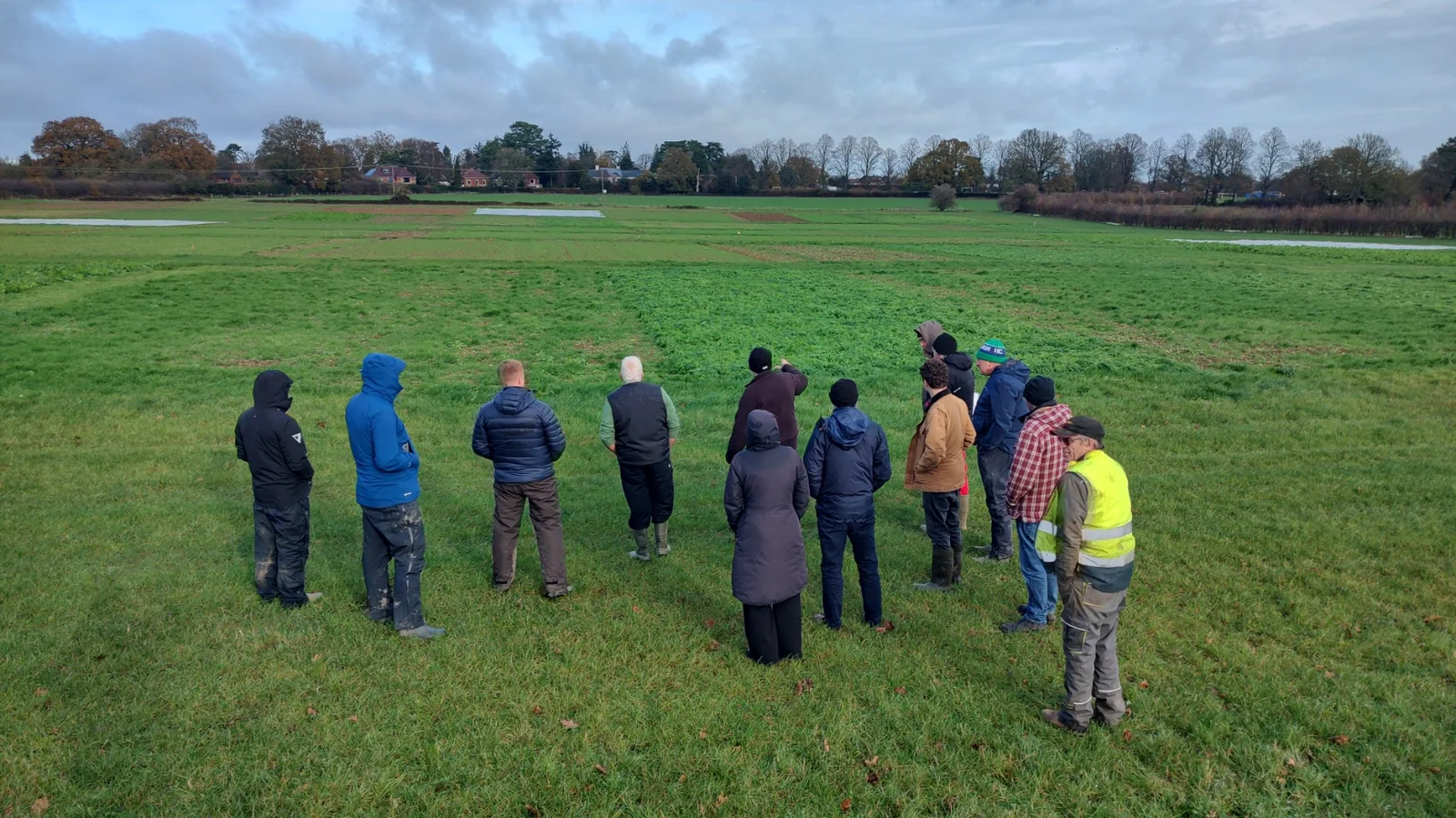
The afternoon programme included an extensive field tour of Rothamsted’s long-term regenerative agriculture experiments, offering participants the chance to see plots under different rotations, amendments, and management strategies.
Two discussion sessions encouraged participants to reflect on: how agricultural science becomes meaningful and trustworthy to practitioners and what farm-level factors influence decisions to innovate or adopt regenerative practices.
Throughout the day, participants were invited to share perspectives via pre- and post-event surveys.
A Day of Evidence, Dialogue, and Practical Insight
Across all presentations and field activities, the workshop showcased how organic amendments can play a central role in sustainable nutrient management, improve soil health, boost yields, and contribute to Europe’s broader transition toward regenerative farming.
By combining long-term research, practical demonstrations, and farmer-led discussion, the event strengthened the bridge between science and practice — and highlighted the potential of organic amendments to support resilient agricultural systems for the future.