

| Communication team
EU policy is catching up with what innovation projects have already been testing on the ground.
The European Commission has recently strengthened measures to reduce Europe’s dependency on imported fertilisers by enabling the wider use of RENURE products under the Nitrates Directive. This is an important signal: nutrient circularity is no longer a fringe discussion; it is entering the regulatory mainstream.
In trans4num, we have been working precisely at this interface between policy ambition and field-level validation.
One example is Thallo™, a phosphorus-rich fertiliser derived from abattoir by-products through a two-stage process that virtually eliminates waste. Within trans4num NBS sites in UK, Rothamsted Research is testing recycled fertilisers like Thallo™ not only for agronomic efficiency, but for their broader environmental and systemic implications.
However, policy momentum alone is not enough.
Circular fertilisers hold real promise, but their environmental performance, territorial suitability, and governance safeguards matter. Questions around nutrient balance, soil health impacts, water quality, traceability, and farmer adoption cannot be assumed; they must be demonstrated.
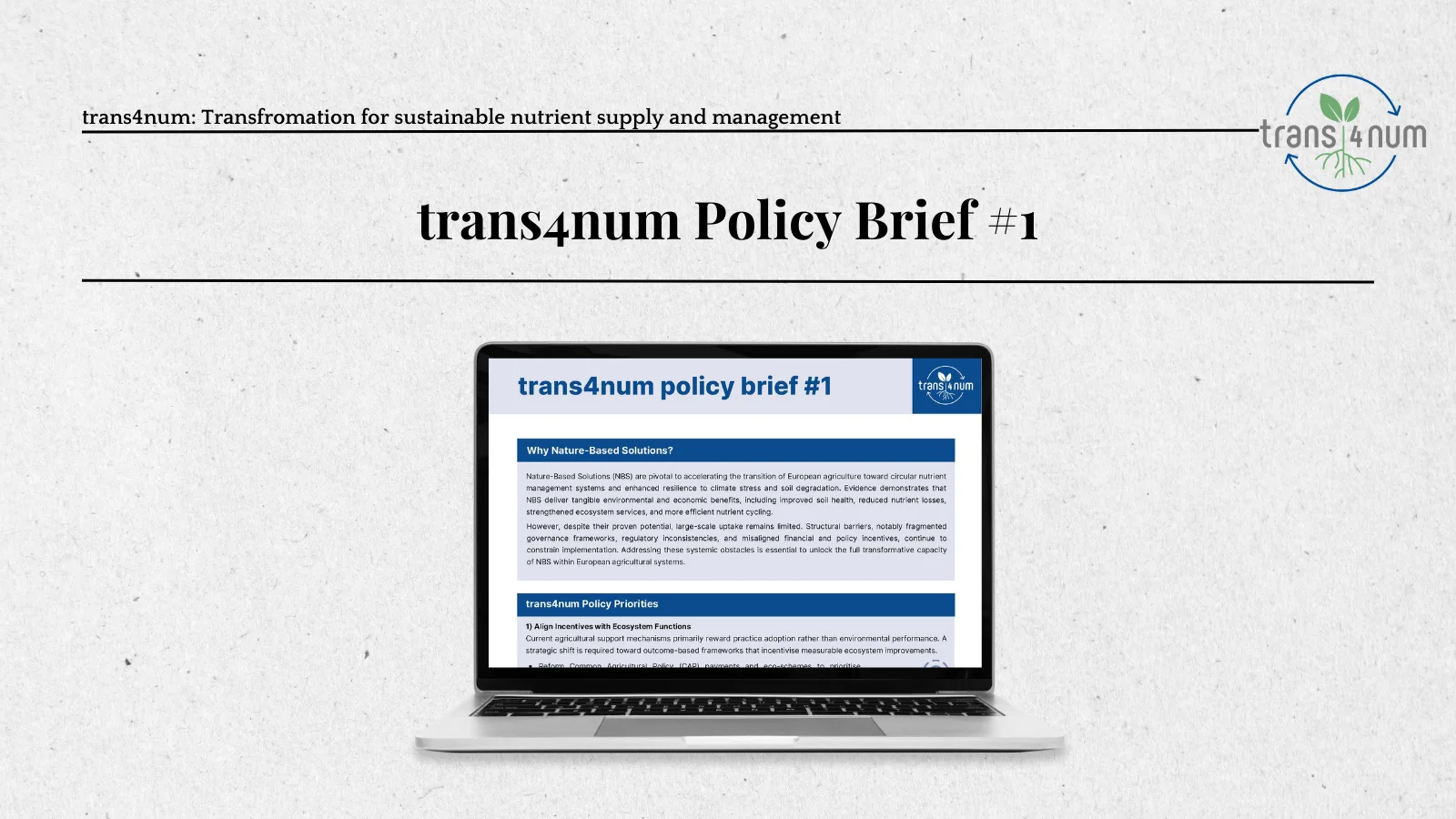
This is precisely why trans4num’s first policy brief outlines three strategic priorities to ensure that innovation and regulation evolve together:
- Align incentives with ecosystem functions
- Embed adaptive governance and continuous learning
- Integrate Nature-Based Solutions across sectors and scales
Align incentives with ecosystem functions
Agricultural support mechanisms must move beyond rewarding the adoption of specific practices and instead incentivise measurable environmental performance.
This means:
- Reforming CAP eco-schemes to prioritise indicators such as soil organic carbon, nutrient balances, biodiversity, and wate quality.
- Explicitly recognising circular nutrient sources, including compost and bio-based fertilisers, within regulatory frameworks.
- Scaling Payment for Ecosystem Services (PES) mechanisms that remunerate farmers for ecosystem restoration and nutrient cycling functions.
Embed adaptive governance and continuous learning
Agroecological transitions are dynamic. Regulatory systems must be able to evolve alongside emerging scientific evidence and on-farm experimentation.
We advocate:
- Adaptive policy instruments supported by participatory monitoring systems and interoperable data platforms such as the Farm Sustainability Tool for Nutrients (FaST).
- Multi-actor nutrient councils that bring together farmers, advisors, researchers, and policymakers to interpret evidence and co-design regionally grounded solutions.
Integrate Nature-Based Solutions across sectors and scales
Nutrient circularity cannot succeed within fragmented policy silos. Stronger coordination is needed across nutrient, water, biodiversity, and bioeconomy strategies, alongside support for regional bioeconomy hubs that link agriculture, renewable energy systems, and biorefineries to strengthen territorial nutrient cycles.
The critical question is whether implementation will be evidence-based, territorially adapted, and governance-ready.
Innovation projects like trans4num can help ensure that regulatory acceleration is matched by scientific robustness and practical feasibility.
Read the trans4num Policy Brief