

| Communication team
On 15 December 2025, the trans4num project was represented at the Econutri Hackathon, where project partner Hanna Frick (Research Institute of Organic Agriculture, FiBL) presented the prototype trans4num Decision Support Tool (DST) for landscape-level nutrient management.
The presentation introduced the DST as a practical, data-driven tool designed to support nature-based solutions (NBS) for sustainable nutrient management by connecting farm-level decisions with landscape-scale environmental outcomes.
Supporting nature-based solutions at landscape scale
The trans4num project aims to substantiate and promote NBS approaches for sustainable agricultural practices in Europe and China, with a particular focus on nutrient management. This includes bio-based nutrient sources, sustainable crop rotations, and integrated management practices.
The DST has been developed as a prototype for the Limfjord region in Denmark, a landscape where nitrogen (N) leaching to coastal waters poses a significant environmental challenge. A key example explored during the hackathon was how N leaching to the fjord could be reduced by increasing permanent grassland cover, while maintaining the economic viability of farms.
Why a Decision Support Tool?
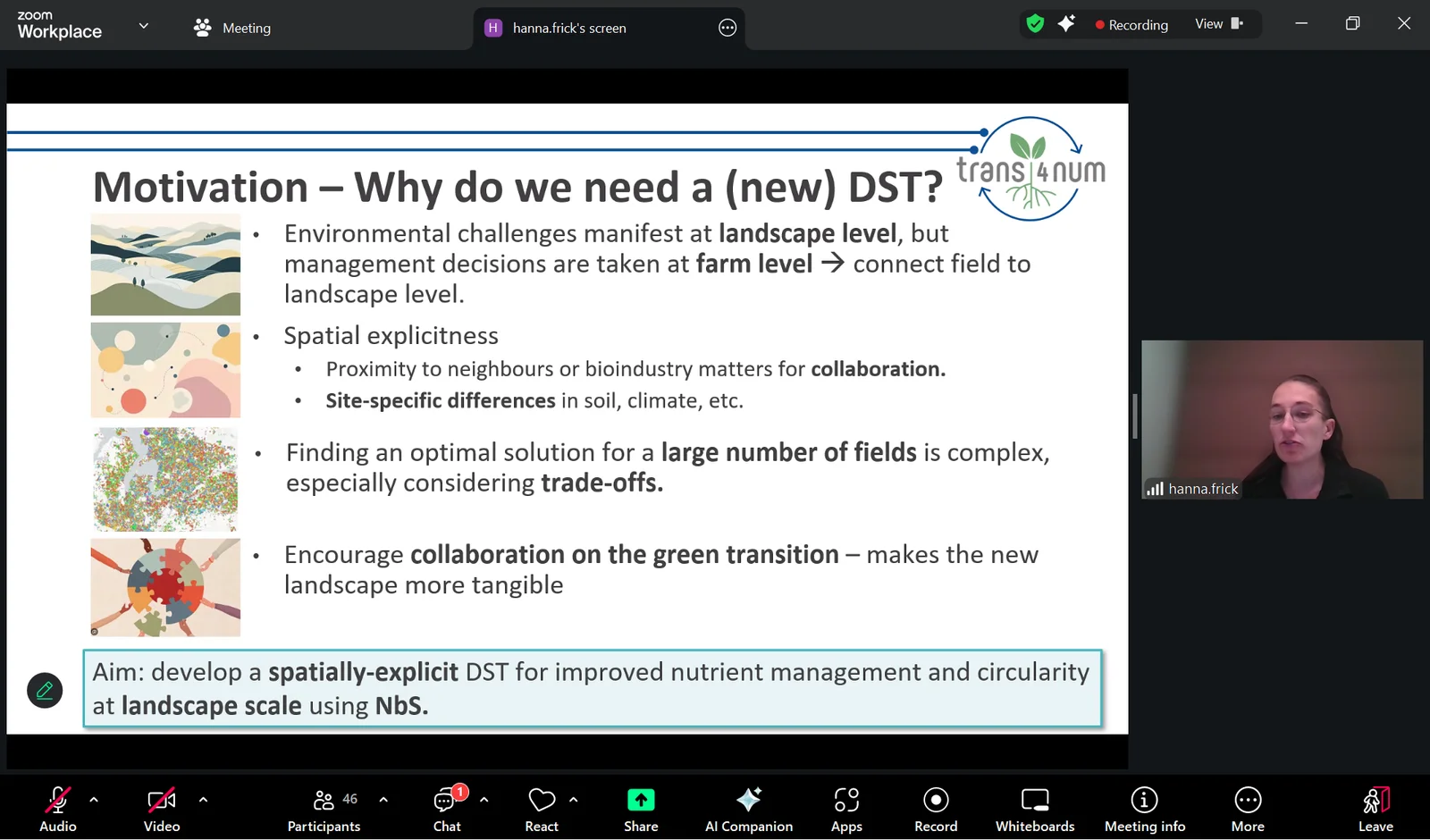
Managing nutrients efficiently across large agricultural landscapes is complex. Environmental challenges such as nutrient losses manifest at landscape level, while management decisions are typically made at field or farm level. The trans4num DST addresses this mismatch by:
- Linking field-level management choices to landscape-level impacts
- Accounting for spatial variability in soils, climate, and proximity to other farms or bio-industries
- Making trade-offs between environmental performance and farm economics explicit
- Encouraging collaboration among stakeholders in the green transition
Importantly, the DST does not prescribe decisions. Instead, it supports joint exploration of scenarios and helps stakeholders understand the broader system impacts of different management options.
How the trans4num DST works
The DST is built around a data-driven optimisation model. Users define their objectives and constraints (for example, reducing nitrogen leaching while limiting economic losses). The tool then evaluates management options for each field and searches for an optimised allocation of crop rotations across the entire region.
Users can inspect results through maps and summary indicators showing:
- Changes in crop rotations
- Economic outcomes
- Nitrogen load reductions
- Differences between current practices and optimised scenarios
The general principle is simple: users describe the desired effects, and the DST calculates an efficient way to achieve them at landscape scale.
Outlook and transferability
Future development of the DST includes the integration of a regional nitrogen balance and enhanced comparison of alternative scenarios. The approach is designed to be transferable to other regions, provided that relevant geographic data, agricultural landscape information, and NBS effect data are available.
By showcasing the trans4num DST at the Econutri Hackathon, the project contributed to dialogue on how digital tools can support collaborative, nature-based nutrient management strategies across Europe.